
Why Cambridge Basements Grow Mold With Nothing Leaking
Summer air does it on its own. The average daily dew point at Boston Logan sits at 60F or higher every day from July 7 through August 23, so any basement surface cooler than that pulls water straight out of ordinary air with no leak anywhere in the building.
Already know you need someone out? Call (315) 640-3590, answered 24/7.
The dew point does it, not a leak
Dew point is the temperature at which the air you are standing in has to give up its water. In the National Weather Service dew point climatology for Boston Logan, the average daily dew point is 60F or higher on every day from July 7 through August 23, a run of 48 consecutive days, and it peaks at 61F where it holds for the whole month from July 15 to August 15. So for most of high summer, every surface in your house below roughly 61F is a condensing surface. A basement wall at 58F does not need a crack, a pipe or a storm to get wet. It only needs the cellar door left open on a humid afternoon. This is the single most misdiagnosed mold cause in Greater Boston, because the search for a source finds nothing, which people read as reassurance rather than as the answer.
Why an old foundation is always the cold surface
Deep masonry and slabs do not follow the weather, they follow the year. The 1991 to 2020 annual average temperature at Logan is 51.9F, while the average daily dew point in midsummer is 61F, so a foundation wall or slab tracking that annual mean sits roughly 9F below the summer dew point and stays there through the hottest weeks of the year. That is a permanent condensing surface for as long as humid air can reach it. The EPA's advice runs the same way: reduce the potential for condensation on cold surfaces such as windows, piping, exterior walls, roofs and floors by adding insulation, and do not lay carpet on concrete floors subject to leaks or frequent condensation. A rubble or brick foundation with no insulation and no conditioning is the textbook case, and this city is full of them.
It arrives suddenly, which is why it feels like something broke
The humid load here does not creep in. The Logan average daily dew point climbs from 51F on June 1 to 58F by June 30 and crosses 60F in the first week of July, so the whole shift happens across about five weeks. To a homeowner that reads as an event: nothing smelled in May, and in the second week of July the basement smells like a cellar. The season is longer than the peak, though, and worth knowing if you are planning work. Logan averages a first 60F dew point on May 6 and a last on November 9, with 65F running from late May to early October. Condensation risk is a six month condition here, not an August one, and a dehumidifier unplugged in September is a dehumidifier that was needed in October.
Opening the window makes it worse, and the code agrees
The instinct to air out a damp basement is exactly wrong for eight weeks of the year, because the air outside is wetter than the air inside and the coldest thing in the room is the wall. What works is closing it up, running mechanical dehumidification, and steering by a reading rather than a smell: the EPA recommends holding indoor relative humidity between 30 and 60 percent, venting bathrooms and dryers outdoors, and using air conditioning and dehumidifiers. The code points the same direction where habitable rooms are concerned. 105 CMR 410.280 requires either openable area of at least 4 percent of the room's floor area or mechanical ventilation at 2 air changes per hour for a habitable room and 5 for a bath, toilet or shower room, and it specifically disqualifies a skylight that exposes the interior to direct rainfall when open.
The housing stock here holds water where you cannot see it
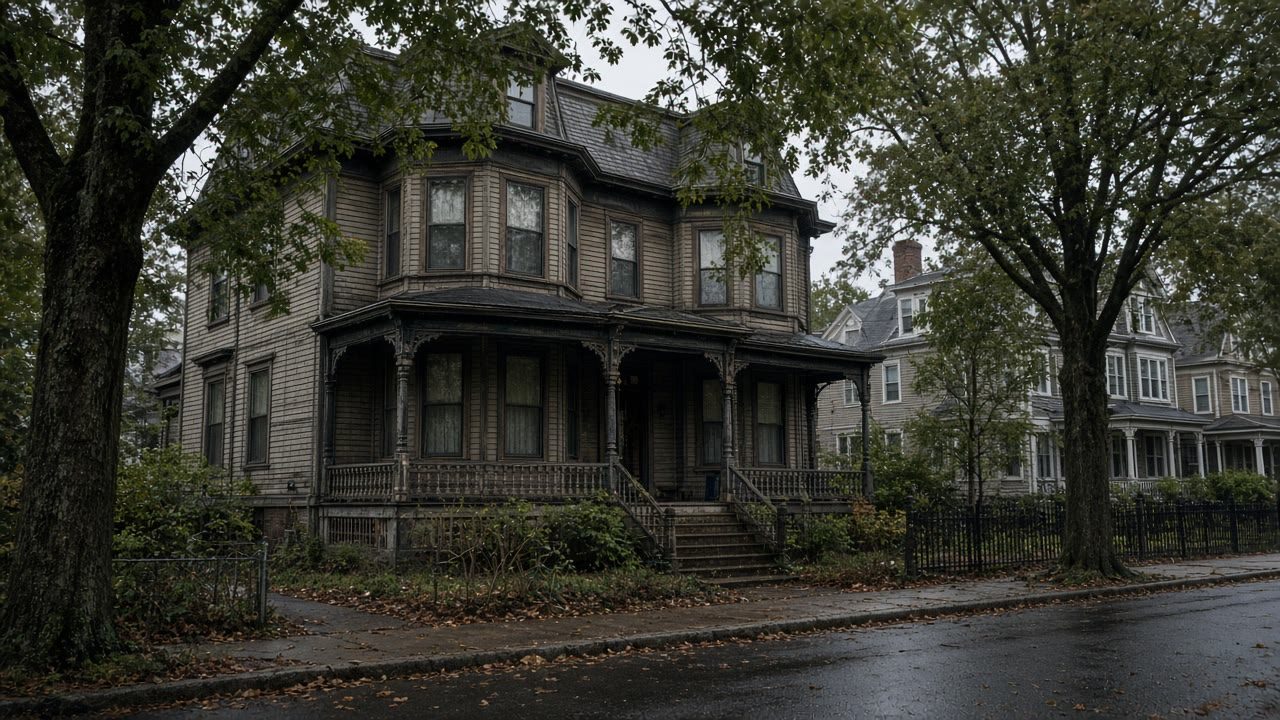
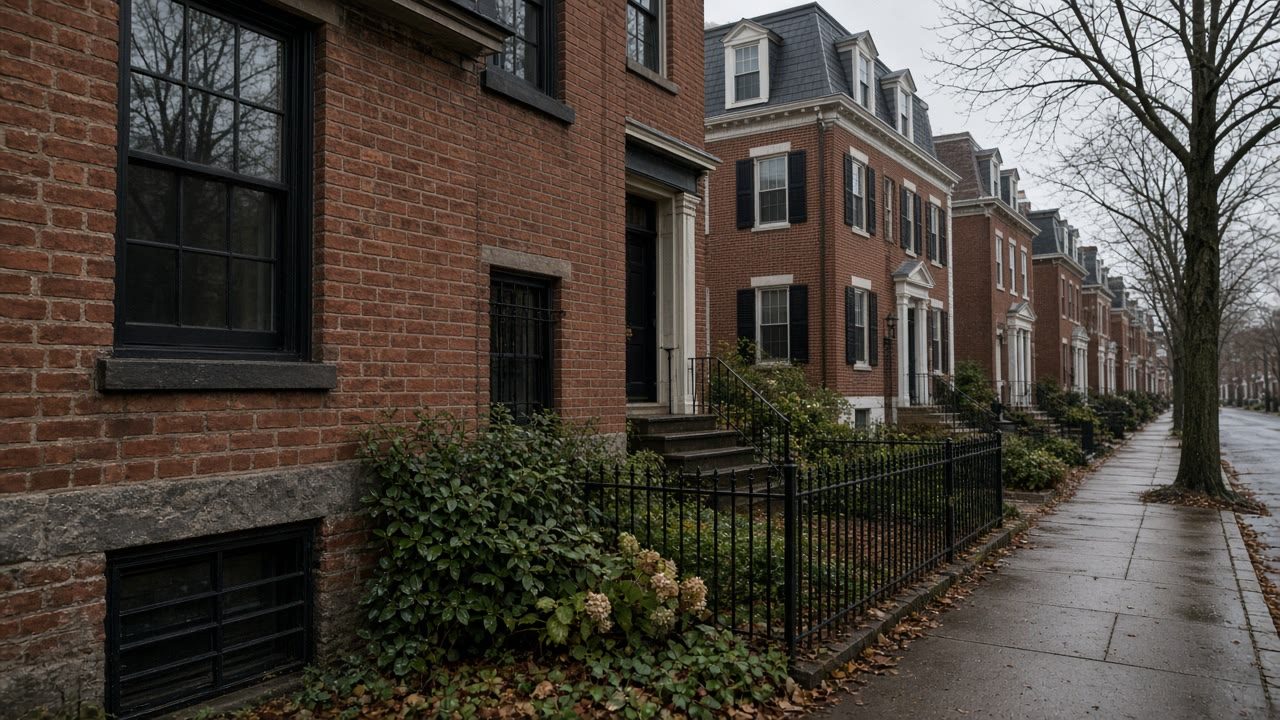
Cambridge has 47.0 percent of its housing units built in 1939 or earlier, a median construction year of 1950, and 67.9 percent built before 1980, with 29.1 percent of units sitting in two, three and four unit structures. What that means in practice is plaster on wood lath, rubble and brick foundations, unconditioned cellars and balloon framing. Those assemblies absorb water and then hide it: the wet area behind a stained wall is routinely larger than the stain, and a cavity that gets damp in July can stay damp into the fall with nothing visible on the finished face. It is also why a meter and a thermal camera find more here than a flashlight does, and why a confident diagnosis made from a photograph of the surface is usually a guess.
There is no dry season to wait for
The 1991 to 2020 monthly precipitation normals for Logan range only from 3.21 inches in February to 4.30 inches in December against an annual normal of 43.59 inches, which means no month is dry enough to let a wet assembly recover on its own. The frequency matters more than the totals: 128.4 days a year with at least 0.01 inches, 77.0 days with at least 0.10 inches, and 10.2 days with an inch or more. Winter adds a second mechanism on top. Logan averages 91.6 days a year below freezing at night but only 23.1 days that stay below freezing, leaving roughly 68 days that freeze and thaw again, and each of those cycles works at mortar joints, parging and the gap under a sill. Nothing about this climate rewards putting off a drainage fix.
Most of the water trouble here is not the river
People near Alewife Brook or the Charles assume the river is the enemy, and the claims record says otherwise. FEMA's flood insurance claims dataset records 15 claims for the City of Cambridge with loss years from 2010 to 2025 and about 107,000 dollars in net building and contents payments, and thirteen of the fifteen were rated in flood zone X, outside the mapped high risk zone, while nine of the fifteen were caused by accumulation of rainfall or snowmelt rather than any river or tidal overflow. That is the ordinary answer being the right one. Gutters, grading, a downspout dumping at the foundation, a window well with nowhere to drain: unglamorous causes with cheap fixes, and they account for more wet Cambridge basements than any mapped floodplain does.
What actually fixes a condensing basement
Three things in order, and only the first is urgent. Stop liquid water arriving from outside, which is drainage, grading and the envelope, and where windows are the suspect 105 CMR 410.530 gives you a measurement instead of an argument: a double hung sash counts as weathertight only with a gap no wider than one eighth of an inch on the perimeter, one sixteenth on a casement, unless a storm window is fitted. Then take the humidity down mechanically and hold it inside the EPA's 30 to 60 percent band with a dehumidifier, air conditioning and dryers and bathrooms vented outdoors. Then separate the warm humid air from the cold surfaces with insulation, and stop storing porous material against the wall. If the damp returns anyway, that is Chronic Dampness under 105 CMR 410.020, and it is worth having somebody read the building properly rather than cleaning the same wall a third time.
Sources used in this guide
In the National Weather Service Boston dew point climatology for Boston Logan Airport, the average daily dew point is 60F or higher on every day from July 7 through August 23, a run of 48 consecutive days.
Source: NOAA National Weather Service, Boston/Norton forecast office, accessed 2026-09-14
The Boston Logan average daily dew point peaks at 61F and holds there for the month from July 15 through August 15, according to the National Weather Service Boston dew point climatology.
Source: NOAA National Weather Service, Boston/Norton forecast office, accessed 2026-09-14
The Boston Logan average daily dew point rises from 51F on June 1 to 58F on June 30 and crosses 60F in the first week of July, so the humid load arrives over about five weeks rather than gradually.
Source: NOAA National Weather Service, Boston/Norton forecast office, accessed 2026-09-14
The National Weather Service Boston records for Boston Logan give an average first 60F dew point of May 6 and an average last of November 9, an average first 65F dew point of May 29 and last of October 9, and an average first 70F dew point of June 23 and last of September 11.
Source: NOAA National Weather Service, Boston/Norton forecast office, accessed 2026-09-14
The 1991 to 2020 annual average temperature at Boston Logan is 51.9F, while the average daily dew point in mid-summer is 61F, so a deep masonry or slab surface that tracks the annual average sits roughly 9F below the summer dew point.
Source: NOAA National Centers for Environmental Information, 1991-2020 Climate Normals, accessed 2026-09-14
The 1991 to 2020 monthly precipitation normals for Boston Logan range only from 3.21 inches in February to 4.30 inches in December, with an annual normal of 43.59 inches, so there is no dry season.
Source: NOAA National Centers for Environmental Information, 1991-2020 Climate Normals, accessed 2026-09-14
The 1991 to 2020 normals for Boston Logan give 128.4 days a year with 0.01 inches or more of precipitation, 77.0 days with 0.10 inches or more, and 10.2 days with 1.00 inches or more.
Source: NOAA National Centers for Environmental Information, 1991-2020 Climate Normals, accessed 2026-09-14
The 1991 to 2020 normals for Boston Logan give 91.6 days a year with a minimum temperature below 32F and only 23.1 days with a maximum below 32F, leaving roughly 68 days a year that fall below freezing and rise above it again.
Source: NOAA National Centers for Environmental Information, 1991-2020 Climate Normals, accessed 2026-09-14
The EPA advises reducing the potential for condensation on cold surfaces such as windows, piping, exterior walls, roofs and floors by adding insulation, and advises against installing carpeting where there is a perpetual moisture problem or on concrete floors subject to leaks or frequent condensation.
Source: U.S. Environmental Protection Agency, accessed 2026-09-14
The EPA recommends reducing indoor relative humidity to between 30 and 60 percent to decrease mold growth, by venting bathrooms and dryers to the outside, using air conditioners and dehumidifiers and increasing ventilation.
Source: U.S. Environmental Protection Agency, accessed 2026-09-14
105 CMR 410.280 requires the owner to provide ventilation to the outdoors for every habitable room and every room containing a toilet, bathtub or shower, either through windows, skylights, doors or transoms in the exterior walls or roof that open to a minimum of 4 percent of that room's floor area, or through mechanical ventilation capable of exhausting air at 2 air changes per hour for habitable rooms and 5 air changes per hour for bath, toilet or shower rooms. A skylight that exposes the interior to direct rainfall when open does not satisfy the requirement.
Source: Massachusetts Department of Public Health, via Cornell Legal Information Institute, accessed 2026-09-14
105 CMR 410.530, the weather-tight elements standard, treats an exterior openable window as weathertight only when every pane is in place, unbroken and properly sealed, the sash opens and closes fully without excessive effort, and either the gap between sash and prime frame is no larger than 1/8 inch anywhere on the perimeter for a double hung window or 1/16 inch for a casement, or a storm window is fitted. The same 1/8 inch limit applies to the sides of an exterior door, and building and structural elements count as weather-tight only when all cracks and spaces that are not part of a heating, ventilating or air conditioning system are sealed to prevent infiltration of exterior air or moisture.
Source: Massachusetts Department of Public Health, via Cornell Legal Information Institute, accessed 2026-09-14
Cambridge has 47.0 percent of its housing units built in 1939 or earlier and a median year of construction of 1950, with 67.9 percent built before 1980. 29.1 percent of its units sit in two, three and four unit structures and 27.1 percent in structures of 50 units or more.
Source: U.S. Census Bureau, American Community Survey 2020-2024 5-year estimates, accessed 2026-09-14
FEMA's NFIP claims dataset records 15 flood insurance claims for the City of Cambridge with loss years from 2010 to 2025 and about $107,000 in net building and contents payments. Thirteen of the 15 were rated in flood zone X, outside the mapped high-risk flood zone, and nine of the 15 were caused by accumulation of rainfall or snowmelt rather than by any river or tidal overflow.
Source: Federal Emergency Management Agency, OpenFEMA NFIP Redacted Claims v2, accessed 2026-09-14
105 CMR 410.020 defines Chronic Dampness as the regular and/or periodic appearance of moisture, water, mold or fungi.
Source: Massachusetts Department of Public Health, via Cornell Legal Information Institute, accessed 2026-09-14
Services this guide relates to
Need someone to look at it?
Send the details and we will come back to you.